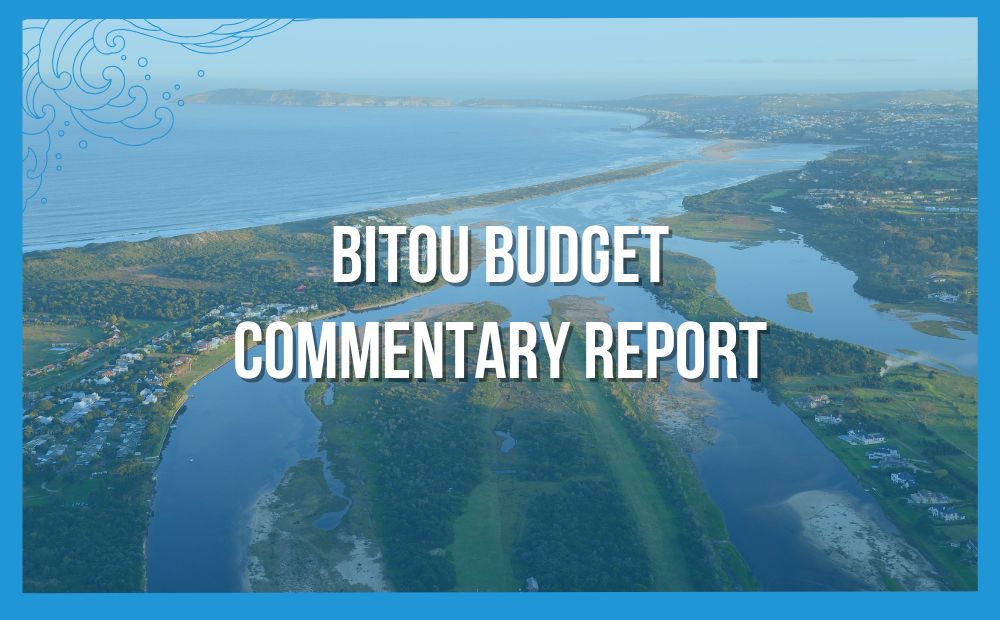
Bitou Budget Commentary Report
· PBRRA
Dear Members,
A critical analysis of Bitou Municipality’s 2026/27 – 2028/29 Medium Term Revenue and Expenditure Framework (MTREF) and recent performance reports reveals that while the short-term financial position appears strong, several underlying trends pose significant concerns to future sustainability.1. The "Too Good to be True" Liquidity vs. Long-Term Debt
The municipality highlights a strong current ratio of 4.30:1 and 4.3 months of cost coverage as evidence of health. However, the Auditor-General and the administration’s own risk registers suggest this is a fragile stability:
- Audit Regression: The municipality’s audit status regressed from a "clean audit" to an unqualified opinion with findings in 2023/24, and further regressed to a qualified opinion in 2024/25.
- Escalating Operational Costs: Overtime expenditure reached 68% of the annual allocation by mid-year 2025/26, indicating a lack of control over internal operational costs.
- Aging Infrastructure Risk: The municipality acknowledges that demand for services continues to outstrip available resources, and aging water, road, and electricity systems are listed among the top ten strategic risks.
- Repairs & Maintenance: The budget allocates R57.3 million for repairs and maintenance. As a percentage of Property, Plant, and Equipment (PPE), R&M has been below 5% of PPE for 4+ consecutive years. This is well below the 8% Treasury benchmark. This results in future increased infrastructure replacement costs and service reliability risks — a problem that compounds over time.
2. Demographic Pressures: Growth vs. The Poor
Our concern regarding population growth and economic migration is supported by the data:
- Expanding Indigent Base: The number of registered indigent households has nearly tripled in recent years, growing from 1,891 in 2018/19 to 5,080 in 2023/24.
- High Poverty Threshold: Bitou maintains a poverty threshold of R5,200 per month, which is nearly 20% higher than the National Treasury norm, further expanding the number of people receiving free services at the municipality's (ratepayers) own expense.
- Impact of Semigration: While semigration has attracted investment, it has also "intensified the need for adequate infrastructure and affordable housing." The municipality admits that the Equitable Share grant is insufficient to cover the true cost of providing free services to this growing base.
3. The Declining CAPEX Trend
There is a clear and concerning downward trend in capital investment over the three-year budget cycle:
- Budget Drop-Off: Capital expenditure is budgeted at R209.8 million for 2026/27, but it is projected to decrease to R189.4 million in year two and further to R175.4 million by year three.
- Spending Failures: Even when funds are budgeted, the municipality has a history of under-spending. It spent only 81% of its 2023/24 capital budget and achieved only 34% spending by mid-year 2025/26.
- Unfunded Mandates: The municipality notes that diminishing grant funding is forcing it to absorb costs for projects originally intended to be funded by National or Provincial allocations.
- Further infrastructure strain. The detailed capital budget (Annexure B) shows a heavy focus on new infrastructure for housing developments (e.g., Ebenezer and Qolweni projects). While deemed socially necessary, this places additional long-term operational pressure on the municipality to maintain these new networks with a revenue base that is already struggling, and water/sewerage capacity that has been exceeded since 2025 and is therefore in violation of environmental legislation.
- Priority on water projects. Bitou Municipality has prioritized water security and resource preservation as the primary focus of its 2026/27 budget and long-term planning due to ongoing water scarcity and drought conditions. It is likely we will still have level 4 restrictions for the next year or two.
Planned and ongoing infrastructure projects for water security include:
1) Major Bulk Water Supply and Storage - Bitou Bulk Water Supply Scheme (Wadrift Dam): Multi-year planning studies are underway for this major supply scheme.
- Keurbooms River to Roodefontein Dam Water Transfer Scheme: This project is divided into two phases, including the construction of a new transfer pipeline (Phase 1) and the upgrading of the existing abstraction works (Phase 2).
- Desalination Plant Refurbishment: Ongoing maintenance to ensure operational efficiency by replacing end-of-life filter cartridges and reverse osmosis membranes.
- Reservoir Upgrades: Planned upgrades for the Nature’s Valley Reservoir and the construction of a new reservoir and pump station in Green Valley.
2) Groundwater Exploration and Development
The municipality is aggressively exploring groundwater sources to augment supply. Key projects include: - George East Fault (Uplands): Drilling and equipping new boreholes and associated delivery pipelines.
- Kwanokuthula Wellfield: Refurbishment of existing boreholes, pumps, and pipelines.
- Kurland and Wittedrift: Ongoing groundwater refurbishment, augmentation, and development of new production boreholes
4. Revenue Collection: The 95% Norm "Mirage"
The budget assumes a 95% collection rate, but actual performance consistently lags:
- Collection Gap: The mid-year annual collection rate for 2025/26 was only 88%.
- Critical "Non-Payment" Zones: Collection rates are catastrophically low in several areas: Green Valley (8%), Kurland (13%), and Kranshoek (15%).
- Debtor Profile: Household debt accounts for 95.3% of the total R423.9 million outstanding, with debt older than 90 days posing a direct risk to financial viability.
5. Employee Costs vs. National Norms
The R405.6 million allocated to employee costs represents a 36% share of operating expenditure. While not yet “excessive” by national standards, the inclusion of a 4.75% general increase plus 2.3% notch increases (totalling ~7%) exceeds the 3.7% CPI projection, suggesting that labor costs are growing faster than the broader economy. In addition, Contracted Services has increased 80.5% over two years (R73m to R132m), so if added to employee costs, plus the cost of employee bursaries, standby allowances, overtime, and other employee perks, employee costs will be almost half of the operational budget. National Treasury’s recommended range is 25% to 40%.
6. Tariff Increases vs. CPI
Treasury guidelines suggest that municipalities should keep tariff increases within the 3% to 6% inflation target range. Bitou’s performance here is mixed.
| Service | Bitou Increase | Treasury Guideline (CPI) | Status |
| Property Rates | 3.0% | 3.7% | Compliant |
| Water | 3.7% | 3.7% | Compliant |
| Sanitation | 3.7% | 3.7% | Compliant |
| Refuse Removal | 9.8% | 3.7% | Above Guideline |
| Electricity | 12.75% | 3.7% | Above Guideline |
The 12.75% electricity increase is particularly noteworthy. While NERSA approved a 9.01% increase for municipal purchases from Eskom, Bitou is passing on a higher increase to consumers, citing a “Cost of Supply Study” to ensure financial viability.
The municipality is caught in an electricity paradox: it relies on electricity sales for 29.5% of its revenue, yet it is forced to implement 12.75% tariff increases that drive consumers toward solar and alternative energy. This “death spiral” for municipal revenue is a national trend, but Bitou’s high reliance makes it particularly vulnerable.
While the water tariff is increasing 3.7%, we are likely to remain on level 4 for the next 12-24 months, with the resulting drought tariffs doubling or tripling consumption charges.Critical Summary
The Bitou budget faces a "pincer effect": on one side, it has a rapidly growing indigent population and aging infrastructure that requires massive investment; on the other, it has a shrinking relative revenue base, a regressing audit status, and declining projected capital spending.
The administration’s own summary admits that local GDP growth is forecasted at a stagnant 0.7% for 2026, making it difficult to improve the financial position without "catalytic economic investment" that has yet to materialize. Without a dramatic improvement in debt collection and a reversal of the declining CAPEX trend, the current liquidity may only be a short-term cushion against a long-term sustainability crisis.
2027/28 Projected Deficit of R21.2M
(MTREF p.35, Table 16)
The middle year of the 3-year plan projects expenditure (R1.169B) exceeding revenue (R1.167B). Either this was known when tabled and should have been corrected, or it signals underestimated future cost pressures. Either way, we will request a resolution plan.
Borrowings Increasing 180% in next 4 Years (R165M → R462M)
(MTREF p.58, Table 29)
While gearing remains at 0%, the absolute debt level constrains future borrowing capacity and places growing repayment obligations on future ratepayers. No 10-year debt sustainability plan has been published.
Water Losses 37.9% vs 30% Target
(MTREF p.51, Table 26)
Almost 8 percentage points above target. If not reduced, water revenue will underperform budget projections, creating a revenue shortfall that must be covered elsewhere. Smart meters will help, but what else is planned.?
Employee Costs Exceeding 35% of Revenue
(MTREF p.62, Table 32)
At 35.9%, with 4.75% + 2.3% notch increases, this ratio will worsen in 2027/28 — the very year an operating deficit is already projected.
Repairs & Maintenance Chronically Below 8% Benchmark
(MTREF p.62, Table 32)
R&M has been below 5% of PPE for 4+ consecutive years. This results in future increased infrastructure replacement costs and service reliability risks — a problem that compounds over time.
Household Affordability Squeeze — 61% Bill Growth Over 6 Years
(MTREF p.28, SA14)
As bills exceed affordability thresholds, non-payment rates may rise, creating a negative cycle of revenue shortfall → tariff increase → further non-payment. The 9% electricity rate shock in 2027/28 will intensify this risk.
In summary, Bitou is in a stronger financial position than many of its peers, but it must balance its ambitions with the reality of a struggling local economy and a declining capital investment trend.
Tony Blignaut,
Chairman
Plettenberg Bay Ratepayers & Residents Association
Plett Ratepayers' & Residents' Association
Help us hold Bitou Municipality to account
Reporting like this is powered by our members. Your subscription funds research, legal action and oversight — and every new member strengthens our mandate.